As Mankato employers work to recruit and retain talent in a competitive labor market, one challenge continues to rise to the surface: childcare.
For working parents, access to reliable, high-quality childcare isn’t a convenience, it’s what makes going to work possible. For employers, that means childcare is not a family issue — it’s a workforce issue that directly impacts hiring, retention, and productivity.
A Local Challenge with Real Business Impact
Here in Mankato, families and employers are feeling the strain. When childcare isn’t available or reliable, parents are forced to reduce hours, turn down opportunities, or leave the workforce – or Mankato – altogether. That creates ripple effects across industries, from healthcare and education to manufacturing and small businesses.
At the same time, childcare providers are facing their own challenges. Rising costs, staffing shortages, and tight margins make it difficult to maintain and expand capacity. In Minnesota, where standards are high and costs continue to increase, maintaining access to quality care requires long-term investment and stability.
What We’re Seeing on the Ground
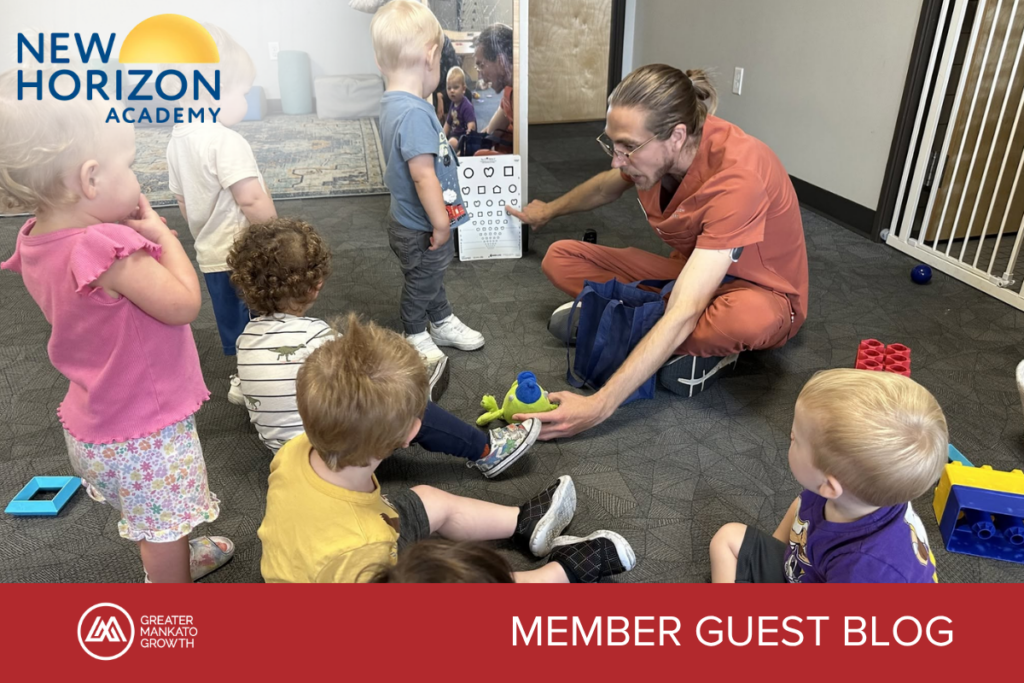
At New Horizon Academy Mankato, we recently stepped in to continue operating a downtown childcare center that would have otherwise closed. For local families, this wasn’t just a change in ownership, it was about continuity.
Children still see the same teachers. Families still rely on the same routines. Parents can continue working without interruption, and the jobs at the childcare center are preserved.
That consistency matters. Young children thrive on familiar relationships and stable environments, and working families depend on that reliability every day.
Why This Matters for Employers
The connection between childcare and workforce participation is direct: when childcare works, your workforce works.
In Minnesota, the cost of infant care can exceed $1,900 per month, making it one of the largest expenses for young families. At the same time, the need for care is greatest during the years when employees are establishing and building their careers.
Childcare is top of mind for employers. Increasingly, businesses are recognizing it as essential infrastructure, something that supports not only employees, but the long-term health of their organizations.
A Legislative Moment — and an Opportunity
Childcare will continue to be a major focus at the state level, as policymakers work to balance affordability for families with sustainability for providers. But policy alone won’t solve the issue.
Minnesota has a history of leadership in early childhood investment, driven in part by the business community’s understanding that investing in childcare pays off.
That opportunity exists again today, particularly in communities like Mankato.
What Employers Can Do
There are several practical steps local employers can take to support childcare access.
- Share federal and state childcare affordability resources with employees:
- Tax benefits
- Federal and state child and dependent care tax credits
- Pre-tax dependent care assistance program
- Federal and state subsidies (income-dependent)
- Tax benefits
- Partner with providers to secure, discount, or prioritize childcare slots for employees
- Provide information about local licensed childcare providers
- Offer flexible spending or childcare benefits
- Collaborate with other employers to create shared solutions
- Advocate for policies that support both families and providers
Even small actions can make a meaningful difference for employees balancing work and family responsibilities. A tax credit (Section 45F) for employers supporting their employees in many of the above ways was greatly expanded last year, and 2026 is the first tax year employers can take advantage of new resources.
A Shared Solution for a Stronger Mankato
Childcare is not a challenge families can solve alone nor one that providers or policymakers can solve in isolation. It requires partnership across the business community.
When we invest in childcare, we invest in our workforce, our businesses, and the future of Mankato.
The bottom line is simple: when young families succeed, our businesses and our community succeed with them.